 blog
blog
Personalized Gifts That Look Expensive: 2026 Guide
Table of Contents
- Why Personalized Gifts Read as Luxury
- Affordable Luxury Personalized Gifts: The Budget-Conscious Approach
- How to Choose High-Quality Custom Gifts
- Best Materials for Custom Engraved Gifts
- Personalized Gifts That Look Expensive for Him and for Her
- Packaging as a Luxury Signal: The Unboxing Moment
- Conclusion: The Gift That Feels Like Them
- Frequently Asked Questions
Last Updated: September 11, 2026
Why Personalized Gifts Read as Luxury
A personalized gift that looks expensive succeeds through restraint, not ornamentation. Clean engraving, solid materials, and considered presentation signal care and cost more reliably than busy design.
This guide from The Crystal Gift Barn covers material selection, budget-conscious sourcing, and the unboxing details that make a custom piece feel bespoke.
Perceived value in gift-giving comes from three signals: material weight, precision of the personalization, and presentation. A lightweight pendant with a crisp, deep engraving reads as higher-end than a heavier piece with shallow, machine-stamped lettering, the gap between a gift worn weekly and one that sits in a drawer (PubMed).
Personalized gifts that look expensive share one trait: they look intentional. Nothing about them feels mass-produced, even when the base item started on a production line.
Affordable Luxury Personalized Gifts: The Budget-Conscious Approach
Affordable luxury personalized gifts work by concentrating spend on one or two visible details instead of spreading it thin. A simple piece with one flawless element outperforms an elaborate piece with several mediocre ones.
A common mistake is chasing size: a larger blanket or plaque does not feel more premium. What feels premium is a smaller item where every surface is finished properly, sealed edges, even stitching, smooth polish, no visible glue lines.
Focus your budget on these instead:
- Engraving quality over engraving quantity. One deep, clean monogram beats a paragraph of shallow text.
- Material honesty. Solid wood, full-grain leather, and sterling silver read as high-end. Coated or plated materials can look convincing at first, then wear through.
- Weight and balance. A gift that feels substantial in the hand signals durability before the recipient even reads the inscription.
How to Spot Elevated Details on a Budget
Elevated details are small, finished touches that cost little but signal craftsmanship: recessed lettering, beveled edges, hand-finished corners, and matching hardware. Look for them in product photos before you buy.
A quick test: zoom in on listing images. Engraving that looks like a flat decal rather than cut into the surface will look cheaper in person, and raw rather than sanded, sealed edges on a wooden plaque will feel unfinished.
consumer guidance on reading product reviews and avoiding misleading listings offers a useful framework for evaluating seller claims before you commit.
How to Choose High-Quality Custom Gifts
Choosing a high-quality custom gift starts with verifying three things: the base material, the personalization method, and the seller's quality control. Skip one and you risk a gift that photographs well but disappoints in hand.
Questions to Ask Before You Order
Ask these before checkout. A seller who can answer them clearly is usually a seller who controls their own production.
- What material is the base item made from, and is it solid or plated?
- How is the personalization applied: laser engraved, hand engraved, printed, or embossed?
- Can I see a proof or mockup before production begins?
- What is the return or replacement policy if the personalization is wrong?
- How long does production take, and when will it ship?
The proof question matters most: a seller who refuses to show a mockup is asking you to gamble on the final result. At The Crystal Gift Barn, most products are designed, assembled, and shipped from a USA factory, supporting a small business here.
Best Materials for Custom Engraved Gifts
The best materials for custom engraved gifts hold a cut cleanly and age well: solid hardwoods, full-grain leather, sterling silver, and brushed stainless steel. They read as expensive not because of the material name on the listing but because of how each responds to light, touch, and time, and understanding that lets you judge a gift before it arrives.
Why Certain Materials Trigger an "Expensive" Read
Perceived value comes from three sensory signals working together: weight, surface response, and edge quality.
- Weight. Dense materials, solid hardwood, sterling silver, full-grain leather, carry mass that the hand registers instantly. A hollow or plated item of the same size feels lighter, and the brain reads that lightness as cheapness before the recipient consciously notices.
- Surface response. Real materials change under light. Sterling silver throws a soft, deep reflection; brushed stainless scatters light in fine lines; full-grain leather absorbs it. Plated and coated surfaces reflect flatly, which is the single most common tell in product photos.
- Edge quality. Where a material meets its edge is where cheapness shows first. Raw wood grain, peeling plating, and frayed stitching are edge failures. Sanded, sealed, and burnished edges are the quiet signal that someone finished the piece by hand.
This is why a small sterling silver pendant with one deep engraving often outperforms a larger plated piece with elaborate text: the smaller item wins on all three signals at once.
How Each Material Behaves Over Time
Durability is the slowest-acting luxury signal: a gift that still looks intentional in five years justifies its cost in a way one that looks tired in six months never can. Here is how the four core materials wear:
| Material | Engraving Method | Look and Feel | How It Ages | Best For |
|---|---|---|---|---|
| Solid hardwood | Laser engraved | Warm, high contrast | Darkens slightly; engraving stays crisp if sealed | Plaques, desk essentials |
| Full-grain leather | Debossed or embossed | Rich, develops patina | Impression deepens; surface gains character | Wallets, journals |
| Sterling silver | Hand or laser engraved | Fine detail, bright | Tarnishes; polishes back to original depth | Jewelry, keepsakes |
| Brushed stainless steel | Laser engraved | Modern, durable | Resists wear; engraving stays sharp indefinitely | Watches, tumblers |
Two patterns matter before you buy. Laser engraving on sealed hardwood is permanent; on unsealed wood it can raise the grain and blur over years. And debossed leather is the only personalization here that improves with use, the impression softens and darkens as the leather patinas, which is why leather goods are the most common "heirloom" category in personalized gifting.
Materials to Approach With Caution
Some materials photograph beautifully and disappoint in hand. Plated base metals ("gold plated" or "silver tone") wear through at contact points, the inside of a ring, a bracelet clasp, within months of daily wear (the FTC). Bonded leather debosses unevenly and can crack at the fold. Acrylic and resin take a clean engraving but feel hollow and warm, undercutting the weight signal.
None of these are disqualifying on their own, a plated piece worn occasionally as a keepsake can last years. The problem is when a plated or bonded item is priced and presented as solid; that is where the gift fails the recipient's in-hand test.
Matching Material to the Recipient's Habits
The most reliable rule is to match the material to how often the gift will be handled. Daily-use items, wallets, watches, tumblers, should be solid, because wear compounds. Occasional-use items, keepsake boxes, display plaques, ornaments, can tolerate lighter material.
Big-box personalization sites print onto a fixed catalog of blanks and usually cannot tell you the base composition.
Personalized Gifts That Look Expensive for Him and for Her
The strongest personalized gifts that look expensive are tailored to the recipient's daily habits, not their demographics. A gift someone uses every week accumulates meaning; one that only comes out on special occasions does not.
For Him: Subtle, Solid, and Built to Last
For the recipient who flinches at anything cutesy, stick to understated personalization: initials on a watch back, a name debossed inside a leather wallet, a small engraved mark on a tumbler. A man who would never wear a heart-shaped pendant will happily carry a wallet with his initials pressed into the leather.
For Her: Keepsake Pieces With Heirloom Potential
For her, pieces that earn the "heirloom" label tend to be jewelry and small accessories with clean lines and durable materials: a personalized necklace with a single engraved pendant, a bracelet with an inside inscription, or a compact keepsake box. Avoid anything trendy; timeless designs get passed down.
Packaging as a Luxury Signal: The Unboxing Moment
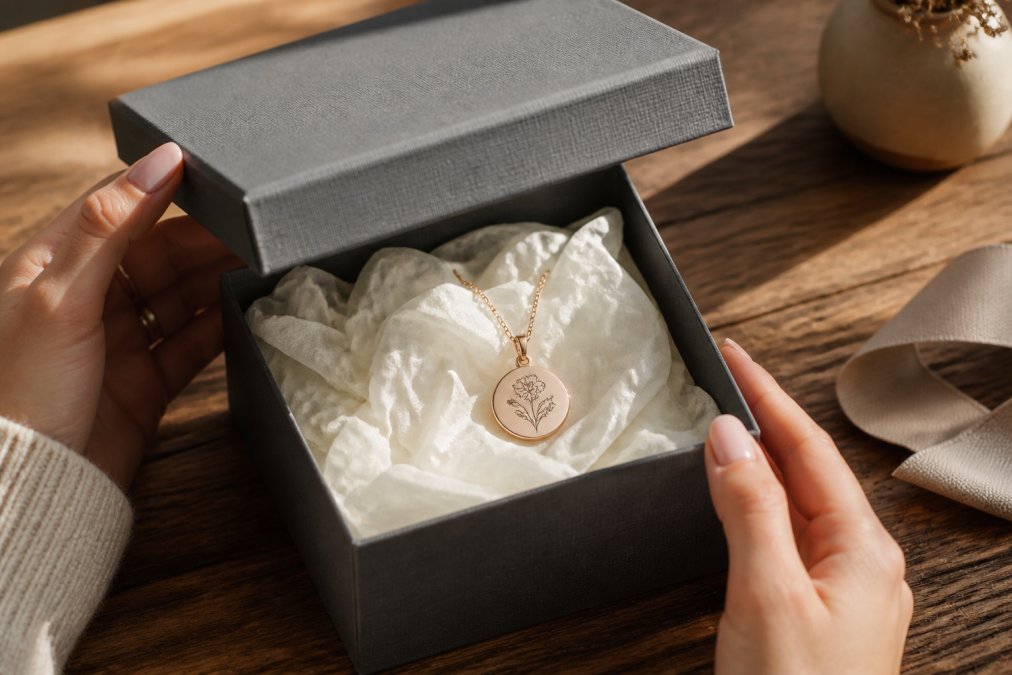
Packaging is the first physical signal of quality a recipient experiences, shaping their impression before they see the gift itself. Most gift guides skip it, but the unboxing sequence is where perceived value is built, and it is the one part of the gift you control completely, regardless of what you spent on the item inside.
The Sequence That Reads as Expensive
Perceived luxury in packaging follows a predictable sequence. Each step buys a few seconds of attention, and the accumulation is what feels expensive:
- The outer layer. A rigid box, not a mailer, not a padded envelope. Rigid construction holds its shape, which signals that the contents were worth protecting.
- The reveal. Tissue paper, folded rather than crumpled, with the gift nested inside. The recipient lifts the tissue; the gift appears. This pause is the single highest-value moment in the entire unboxing.
- The weight transfer. The recipient picks up the item. This is where material quality does its work, and where a lightweight item needs packaging to compensate.
- The written layer. A handwritten note, not a printed packing slip. Handwriting is the strongest low-cost luxury signal available, because it cannot be automated.
How to Make a Modest Gift Feel Considerably More Expensive
The gap between a $20 gift and a $200 gift is often narrower than shoppers assume. Here is where the difference actually lives:
- Skip the branded bag. A printed shopping bag reads as retail, not as a gift. A rigid, textured keepsake box the recipient can reuse does more for perceived value, because it survives the moment and becomes part of the gift.
- Replace the packing slip. A printed invoice is transactional. A handwritten card on heavy cardstock is not. Heavy cardstock, 100 lb or higher, has a stiffness and snap that thin paper cannot imitate, and it costs cents per card.
- Use one accent, not five. A single ribbon in a matte finish, or a single wax seal, reads as considered. Multiple competing embellishments read as busy, and busy reads as cheap.
- Match the finish to the material. Matte packaging around a brushed stainless item, or textured paper around leather, creates a coherent tactile story. Glossy packaging around a matte item creates friction the recipient feels without naming.
- Weight the box. A small, dense object in a large, light box feels wrong. Match box size to item size so the lift feels intentional.
Gift-givers who consistently get the "this looks expensive" reaction spend roughly as much attention on presentation as on item selection. Presentation is not decoration, it is the frame that tells the recipient how to read what is inside.
Sustainable Luxury and the Reusable Box
This is where sustainable luxury is heading: reusable packaging, recyclable materials, and pieces built to last are increasingly what thoughtful buyers seek. A rigid keepsake box reused for jewelry, letters, or photographs extends the gift's life far beyond the initial moment.
Durability is the quietest luxury signal: a gift that still looks good in five years justifies its cost far better than one that looks tired in six months. The same applies to the box, a flimsy mailer goes in the recycling bin the same day, while a solid box stays on a shelf, and every time the recipient sees it, they re-experience the gift.
Conclusion: The Gift That Feels Like Them
The hardest part of gift-giving is finding something that feels specific to the person rather than pulled off a shelf.
The Crystal Gift Barn builds its collection around that problem, with personalized necklaces, watches, blankets, and custom plaques designed and assembled with care. Every order is backed by a 100% customer satisfaction guarantee, and most products are designed, assembled, and shipped from a facility here. Get started with The Crystal Gift Barn and give a keepsake that feels made for them.
Frequently Asked Questions
How do you make a personalized gift look more expensive?
Focus on details that signal care: choose premium materials like solid wood, leather, or sterling silver; keep engraving subtle with a clean serif or script font; and present the item in a structured keepsake box rather than a plain mailer. A monogrammed or engraved piece with a short, meaningful message reads as higher-end than a busy design. Material weight, finish consistency, and how the gift is wrapped all shape perceived value before the recipient even sees the item.
What are the best materials for high-end personalized gifts?
Sterling silver, full-grain leather, and solid hardwoods are materials that hold up over time and feel substantial in hand. For engraved pieces, solid metals and hardwoods accept crisp detail without chipping, while coated or plated surfaces can wear thin.
How can I choose a custom gift that doesn't look cheap?
Start by examining the sample photos: crisp edges, even engraving depth, and consistent color across the piece are signs of quality work. Ask about the base material and the finishing process. Avoid designs with too many competing elements. A single engraved line on a well-made piece almost always looks more expensive than a crowded layout on a budget blank.
Are personalized gifts considered thoughtful luxury?
Yes. Custom engraving, monogramming, or a handwritten note turns a standard item into a keepsake, which raises its perceived value well beyond the base product. Thoughtful luxury is about fit, not price: a gift that names the recipient, marks a specific date, or reflects a shared memory carries more weight than a generic high-ticket item. Presentation and material quality reinforce that impression when the box is opened.